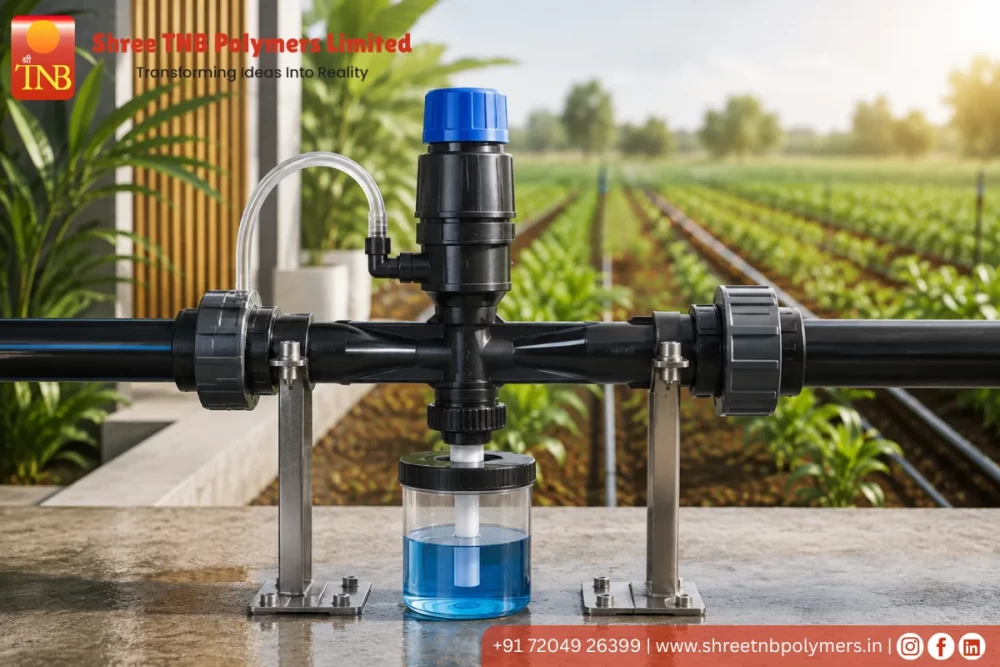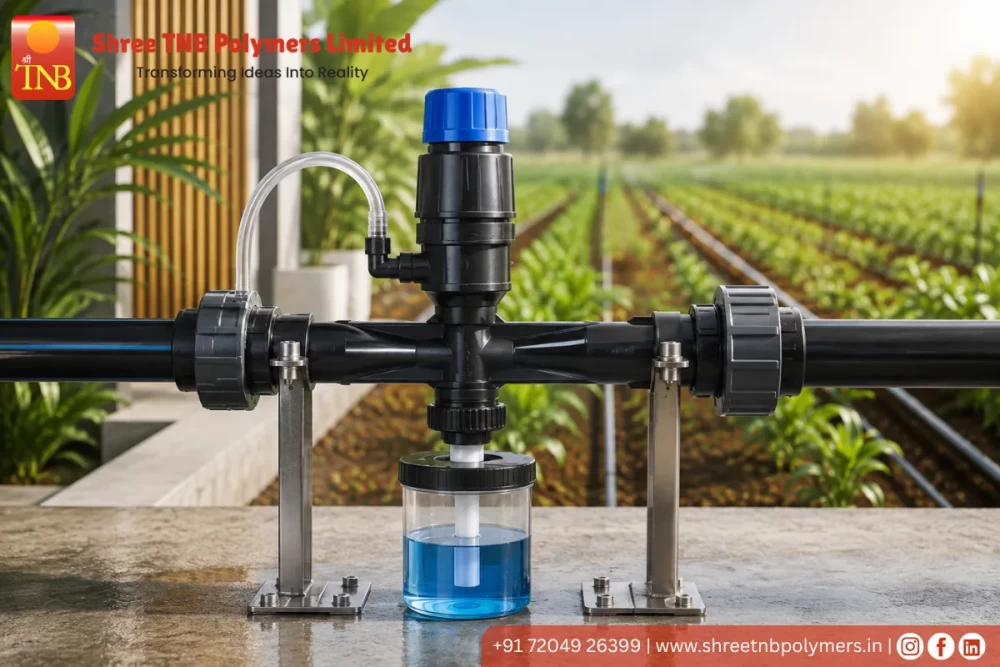
Modern agriculture is increasingly focused on using water, fertilizers, and other inputs more efficiently. Instead of applying irrigation and nutrients separately, farmers can combine the two through fertigation—the application of water-soluble fertilizers through an irrigation system.
A Venturi Injector is one of the commonly used components for this purpose. It uses the pressure and flow characteristics of the irrigation water to draw a fertilizer solution into the main water stream, allowing nutrients to be distributed through the irrigation network.
This approach can be particularly useful in drip irrigation, where water and nutrients can be delivered closer to the crop root zone.
However, a Venturi injector is not simply a device that can be installed anywhere in a pipeline. Its performance depends on factors such as water pressure, flow rate, injector configuration, fertilizer concentration, and the design of the irrigation system.
This guide explains how a Venturi Injector for Irrigation works, its key benefits, applications, and what to consider before choosing one.
What Is a Venturi Injector?
A Venturi Injector is a device used to introduce a liquid, such as a water-soluble fertilizer solution, into an irrigation water stream.
It works on the Venturi principle. As water passes through a specially designed narrow section inside the injector, its velocity increases and pressure changes. This pressure difference creates a suction effect that draws the fertilizer solution from a connected container or tank into the irrigation pipeline.
The fertilizer solution then mixes with the irrigation water and travels through the system toward the crops.
A typical arrangement includes:
- Irrigation water source
- Pump or pressurized water supply
- Venturi injector
- Fertilizer solution tank
- Irrigation pipeline
- Drip or sprinkler system
The exact configuration depends on the irrigation design and the injector being used.
How Does a Venturi Injector Work?
Understanding the basic working principle makes it easier to see why these devices are useful in agricultural fertigation.
Step 1: Water Enters the Injector
Pressurized irrigation water enters the Irrigation Venturi Injector through the inlet.
Step 2: Water Passes Through the Narrow Section
The internal design of the injector causes the water to accelerate as it moves through a narrower section.
Step 3: Pressure Difference Creates Suction
The change in water velocity produces a pressure difference that creates suction at the injector's suction port.
Step 4: Fertilizer Solution Is Drawn In
The suction pulls the prepared fertilizer solution from the connected tank into the injector.
Step 5: Nutrients Mix With Irrigation Water
The fertilizer solution combines with the irrigation water and moves through the irrigation pipeline.
Step 6: Fertilized Water Reaches the Crop
The nutrient-containing irrigation water is then distributed through the irrigation system.
The effectiveness of the process depends on maintaining suitable pressure and flow conditions. If those conditions are inadequate, the injector may not draw fertilizer solution effectively.
What Is Fertigation?
Fertigation is the application of fertilizers through an irrigation system.
Instead of applying irrigation water and fertilizer independently, farmers can introduce suitable water-soluble nutrients into the irrigation network.
A Venturi Fertilizer Injector can therefore become an important component of a fertigation system.
Depending on the crop and irrigation setup, fertigation can help farmers manage nutrient application more precisely and deliver nutrients along with irrigation water.
This approach is commonly associated with:
- Drip irrigation
- Greenhouse cultivation
- Horticulture
- Vegetable farming
- Orchards
- Plantation crops
- Commercial agriculture
The fertilizer used must be compatible with the injection equipment and irrigation system.
Benefits of Using Venturi Injectors
1. Efficient Fertilizer Application
One of the major advantages of a Venturi Injector for Agriculture is the ability to introduce water-soluble fertilizer into the irrigation stream.
Rather than distributing fertilizer separately across the field, the irrigation network can carry the nutrient solution to different areas.
This can make fertilizer application more convenient and easier to integrate into regular irrigation operations.
2. Supports Better Nutrient Distribution
When the irrigation system is properly designed and operated, fertigation can help distribute nutrients through the same network used for water delivery.
This is particularly useful for crops irrigated through drip systems, where water is delivered near the root zone.
A properly managed Fertilizer Injection System can therefore support more controlled nutrient delivery.
However, uniform nutrient distribution depends on the overall irrigation system. A Venturi injector alone cannot compensate for poor hydraulic design, uneven pressure, or inadequate irrigation distribution.
3. Simple Mechanical Operation
A major reason farmers consider Venturi injectors is their relatively simple operating principle.
Unlike electrically powered injection systems, a conventional Venturi injector can use the existing water flow and pressure difference to create the suction needed for fertilizer injection.
This can make the system practical for agricultural applications where simple equipment is preferred.
4. Useful for Drip Irrigation Systems
Venturi Injectors are commonly associated with drip irrigation and other pressurized irrigation systems.
Drip irrigation already provides controlled water delivery to crops. Adding fertigation allows suitable nutrients to be introduced through the same network.
This can help integrate:
Water + Fertilizer + Irrigation
into a single operating process.
The injector must still be selected according to the pressure, flow, and design requirements of the specific Drip Irrigation System.
5. Helps Support Precision Irrigation
Modern agriculture increasingly focuses on delivering inputs according to actual crop requirements.
When properly designed, a Venturi Injection System can support this approach by allowing water-soluble fertilizers to be introduced during irrigation.
This can be useful for Precision Irrigation and crop nutrient management, particularly when irrigation schedules and fertilizer application are carefully planned.
The objective is not simply to apply more fertilizer, but to apply an appropriate amount at the right time and through a suitable delivery method.
Venturi Injectors in Modern Agricultural Irrigation
A modern irrigation system can include several interconnected components:
- Water source
- Pump
- Filters
- Pipes
- Valves
- Venturi injector
- Fertilizer tank
- Drippers or sprinklers
The Venturi injector becomes part of this larger system rather than operating independently.
Major Applications of Venturi Injectors
A Venturi Injector can be used in different agricultural irrigation setups where water-soluble fertilizers or other compatible solutions need to be introduced into the irrigation water.
Common applications include:
- Drip irrigation
- Greenhouse cultivation
- Vegetable farming
- Orchards
- Nurseries
- Horticultural crops
- Plantation agriculture
- Commercial farming
The injector should always be selected according to the water pressure, flow requirements, solution being injected, and overall irrigation design.
Venturi Injectors for Drip Irrigation
A Venturi Injector for Irrigation can be particularly useful in drip irrigation systems because water and nutrients can be delivered through the same network. In a typical setup, filtered irrigation water passes through the system while the injector draws a prepared fertilizer solution into the water stream. The nutrient-containing water then travels through the irrigation pipeline and reaches the crop through the drip emitters.
This approach can help farmers combine irrigation and fertilizer application without creating a completely separate distribution system.
However, uniform fertigation still depends on proper irrigation design. Pressure differences, inadequate filtration, incorrect fertilizer concentration, or poor system maintenance can affect the final distribution.
Venturi Injectors for Fertigation
A Venturi Fertilizer Injector is commonly used when farmers want to apply water-soluble nutrients through irrigation.
The process can be summarized as:
Fertilizer Solution → Venturi Injector → Irrigation Water → Pipeline → Crop
This can make fertilizer application more integrated with irrigation scheduling. Depending on crop requirements, farmers may use fertigation to manage nutrients during different stages of crop growth. The fertilizer should be completely suitable for the application and sufficiently soluble to avoid unwanted deposits or blockages within the irrigation system.
How to Choose the Right Venturi Injector
Choosing a Venturi Injector for Agriculture requires more than selecting a model based on pipe size.
Consider the following factors before purchasing.
1. Water Flow Rate
The irrigation system must provide an appropriate flow for the injector to operate effectively.
Check:
- Minimum flow requirement
- Maximum flow requirement
- Pump capacity
- Pipeline flow
- Number of irrigation zones
An injector that is too large or too small for the system may not provide the expected injection performance.
2. Operating Pressure
Water pressure is another critical factor.
A Venturi injector relies on a pressure difference to create suction. If the available pressure conditions are insufficient, fertilizer solution may not be drawn into the irrigation stream at the desired rate.
Before selecting an injector, check the operating pressure required by the specific product and compare it with the actual pressure available in the irrigation system.
This is one reason why Venturi injector selection should be based on the complete irrigation design rather than the injector alone.
3. Required Injection Rate
The required fertilizer injection rate depends on the crop, irrigation schedule, fertilizer concentration, and fertigation strategy.
A suitable injector should allow the required quantity of fertilizer solution to be introduced under the system's actual operating conditions.
Avoid assuming that a higher injection capacity is automatically better. The injector should match the requirements of the irrigation system.
4. Fertilizer Compatibility
Not every fertilizer or agricultural chemical should automatically be used with every injection system.
Before using a fertilizer solution, check:
- Solubility
- Compatibility with the irrigation system
- Compatibility with injector materials
- Recommended concentration
- Potential for precipitation
- Potential for clogging
Using incompatible products can create problems in the injector, filters, pipes, or emitters.
Importance of Filtration
Filtration plays an important role in a reliable Fertigation System. Before fertilizer injection, irrigation water should be appropriately filtered according to its quality and the requirements of the irrigation equipment.
A suitable Irrigation Filter can help reduce particulate matter entering the system. This becomes especially important in drip irrigation because small emitter passages can be affected by suspended particles.
A well-designed system may therefore include:
Water Source → Pump → Filter → Venturi Injector → Irrigation Pipeline → Drip Lines
Common Mistakes When Using Venturi Injectors
Even a good-quality injector can perform poorly if it is incorrectly selected or installed.
Using Insufficient Pressure
If the system does not provide suitable pressure conditions, the Venturi may not generate adequate suction.
Ignoring Flow Requirements
The injector needs appropriate water flow to operate effectively.
Using Poorly Soluble Fertilizers
Undissolved material can enter the irrigation system and contribute to clogging.
Skipping Filtration
Introducing fertilizer into poorly filtered irrigation water can increase maintenance problems, especially in drip systems.
Incorrect Fertilizer Concentration
The concentration should be calculated according to crop requirements and the fertigation plan rather than estimated casually.
Incorrect Installation
Incorrect piping, valves, bypass arrangements, or connections can affect injector performance.
How to Maintain a Venturi Injector
Regular maintenance helps keep an Irrigation Fertilizer Injector working consistently.
Maintenance may include:
- Inspecting the injector
- Checking suction performance
- Cleaning the suction line
- Inspecting connections
- Checking valves
- Flushing the system
- Monitoring pressure
- Cleaning associated filtration equipment
The exact maintenance schedule should follow the manufacturer's recommendations and the operating conditions of the farm.
If fertilizer residues are allowed to accumulate, they may affect the injector or other irrigation components.
Benefits of Venturi Injection for Water and Nutrient Management
Modern agriculture increasingly focuses on Water-Saving Irrigation, efficient fertilizer use, and better crop management.
A properly designed Venturi-based fertigation system can support these goals by combining nutrient delivery with irrigation.
Potential advantages include:
- Simplified fertilizer application
- Integrated nutrient delivery
- Better use of irrigation infrastructure
- Flexible fertigation scheduling
- Reduced need for separate fertilizer distribution
- Compatibility with many pressurized irrigation systems
However, these benefits depend on correct system design and operation. A Venturi injector itself does not guarantee fertilizer savings or higher crop yields.
How to Choose a Venturi Injector Manufacturer or Supplier
When purchasing a Venturi Injector, the supplier should be evaluated on more than price.
A reliable Venturi Injector Manufacturer or Venturi Injector Supplier should provide clear information about:
- Flow requirements
- Operating pressure
- Injection capacity
- Product materials
- Installation method
- Maintenance requirements
- Application suitability
For larger agricultural projects, technical support can be particularly valuable because injector performance depends heavily on the surrounding irrigation system. If you are looking for a Fertigation Equipment Supplier, compare products based on technical suitability and long-term reliability rather than selecting purely on the lowest quotation.
Venturi Injector Buying Checklist
Before you Buy a Venturi Injector, check:
Water Conditions
Understand the available flow and operating pressure.
Irrigation System
Identify whether the injector will be used with drip irrigation, sprinklers, or another pressurized system.
Fertilizer
Confirm that the fertilizer is suitable and sufficiently soluble.
Injection Requirement
Determine the desired fertilizer injection rate.
Filtration
Ensure appropriate filtration is available before the fertilizer enters the irrigation network.
Installation
Check the required installation configuration and available pipeline space.
Maintenance
Understand how the injector and associated components should be cleaned.
Supplier
Choose a supplier that provides clear specifications and technical support.
Conclusion
A Venturi Injector can be a practical component for modern agricultural fertigation systems. By using the pressure and flow characteristics of irrigation water, it can draw a compatible fertilizer solution into the water stream and distribute nutrients through the irrigation network.
Its simplicity makes it suitable for many applications, particularly Drip Irrigation Systems, horticulture, nurseries, and other agricultural operations.
But selecting the right injector is important. Water pressure, flow rate, fertilizer compatibility, filtration, injection requirements, and installation all influence performance.
The best approach is to treat the Venturi injector as one component of a complete irrigation system. When properly selected, installed, and maintained, it can support more convenient fertilizer application and integrated Crop Nutrition and irrigation management.
Gallery