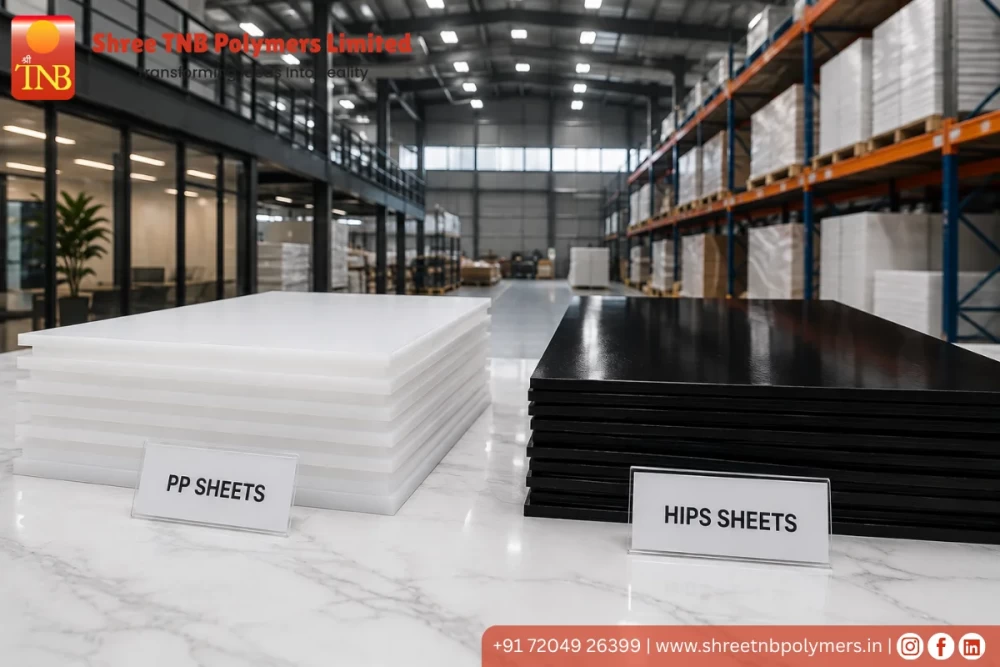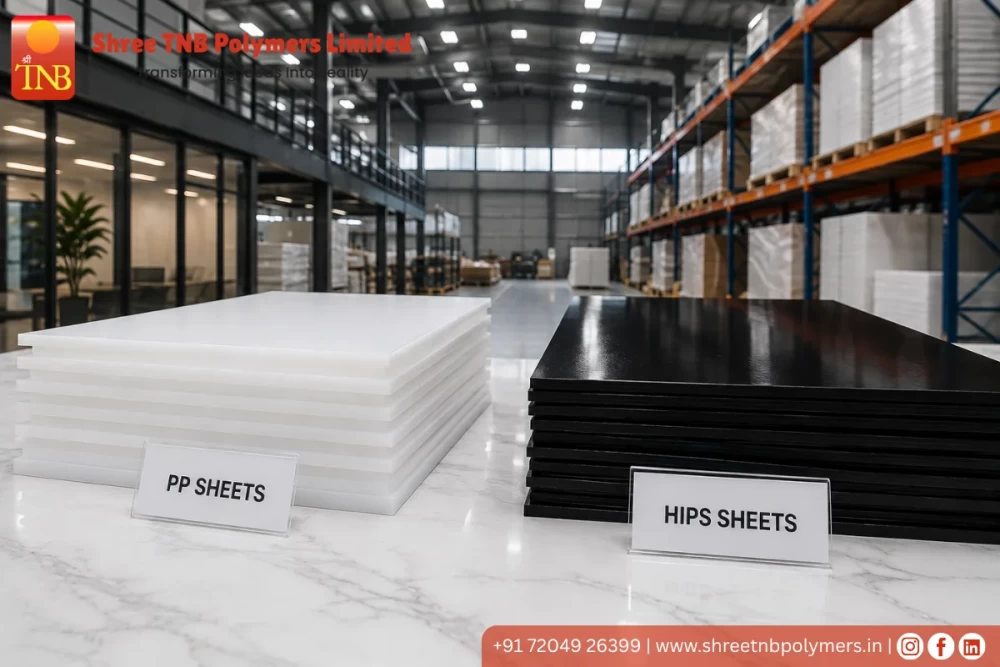
Choosing the right plastic sheet is important for industrial applications where material performance, durability, fabrication, and operating conditions can directly affect the final result. Two materials that are commonly considered for different industrial requirements are PP Sheets and HIPS Sheets.
Although both are thermoplastic sheet materials, they have different properties and may perform better in different applications. PP Solid Sheets, made from polypropylene, are known for their chemical resistance, moisture resistance, and durability. HIPS, or High Impact Polystyrene, is valued for its impact resistance, ease of fabrication, and smooth surface.
Understanding the differences between PP and HIPS can help industrial buyers select a material that matches their application instead of choosing solely on price or availability.
What Are PP Sheets?
PP Sheets are solid plastic sheets manufactured from polypropylene, a thermoplastic polymer widely used across industrial applications.
Polypropylene offers a useful combination of chemical resistance, low moisture absorption, durability, and relatively low density. These characteristics make PP sheets suitable for applications where the material may come into contact with chemicals, moisture, or corrosive environments.
Depending on the application, PP sheets can be fabricated, cut, welded, machined, or formed into different components.
Key Characteristics of PP Sheets
Some important characteristics include:
- Good chemical resistance
- Low moisture absorption
- Good durability
- Lightweight construction
- Easy fabrication
- Resistance to many acids and alkalis
Because of these properties, polypropylene sheets are commonly considered for industrial tanks, liners, fabricated components, partitions, and other applications where chemical and moisture resistance are important.
What Are HIPS Sheets?
HIPS Sheets are manufactured from High Impact Polystyrene. HIPS is a modified form of polystyrene designed to provide improved impact resistance compared with standard polystyrene.
One of its advantages is its ease of processing and fabrication. HIPS sheets can be cut, shaped, and thermoformed for applications where appearance, ease of manufacturing, and impact performance are important.
HIPS plastic sheets are commonly used for applications such as protective components, fabricated parts, displays, housings, and various industrial and commercial products.
PP Sheets vs HIPS Sheets: Key Differences
While both materials can be used in sheet form, their properties are different.
The right choice depends on what the sheet needs to withstand during actual operation.
Chemical Resistance
Chemical resistance is one of the major advantages of PP Solid Sheets.
Polypropylene generally performs well against many acids, alkalis, and other chemicals, making it useful for certain chemical-processing and fabrication applications.
HIPS, on the other hand, has more limited chemical resistance and may not be the preferred option where the sheet will be exposed to aggressive chemicals.
Therefore, for applications involving regular chemical exposure, PP may be a more suitable material depending on the specific chemical, concentration, temperature, and exposure time.
Impact Resistance
HIPS was specifically developed to improve the impact resistance of conventional polystyrene.
This makes HIPS useful where the material needs to withstand physical impact or where toughness is an important consideration.
PP also provides good toughness and impact performance, but the actual performance of either material depends on grade, thickness, temperature, and application conditions.
Moisture Resistance
PP has very low moisture absorption, which can be beneficial in applications involving water or humid environments.
This characteristic helps maintain the material's properties when exposed to moisture.
HIPS can also be used in certain environments where moisture exposure is controlled, but PP may be preferred when moisture resistance is a key requirement.
Which Material Is Better for Industrial Applications?
There is no universal answer to whether PP or HIPS is better. The correct material depends on the operating conditions and the performance requirements of the application.
PP Sheets may be a better choice when the application requires strong chemical resistance, low moisture absorption, and durable performance in demanding environments. HIPS Sheets may be more appropriate where impact resistance, ease of fabrication, appearance, or thermoforming characteristics are more important. Before selecting a material, industrial buyers should consider the complete application rather than comparing materials based on a single property.
Applications of PP Sheets
PP sheets are used in a wide range of industrial applications because of their chemical resistance and fabrication characteristics.
Common applications can include:
- Chemical tanks and containers
- Tank liners
- Industrial partitions
- Fabricated equipment
- Protective linings
- Chemical-processing components
- Industrial enclosures
The specific PP grade and sheet thickness should be selected according to the application's operating requirements.
Applications of HIPS Sheets
HIPS sheets are used where impact resistance, ease of processing, and surface appearance are important.
Typical applications may include:
- Protective components
- Machine covers
- Fabricated parts
- Product housings
- Displays
- Packaging-related applications
- Thermoformed components
The suitability of HIPS depends on the expected mechanical, chemical, and environmental conditions.
Factors to Consider Before Choosing
Industrial buyers should evaluate several factors before purchasing plastic sheets.
Operating Environment
Consider whether the sheet will be exposed to chemicals, moisture, heat, UV radiation, or mechanical stress.
Required Strength and Impact Resistance
Determine how much physical stress or impact the material is expected to experience during operation.
Chemical Exposure
If chemicals are involved, verify the material's compatibility with the specific chemical rather than relying only on general chemical-resistance claims.
Fabrication Requirements
Consider whether the sheet needs to be cut, welded, machined, thermoformed, or fabricated into a larger component.
Thickness and Dimensions
Sheet thickness and dimensions should be selected according to the application's structural and fabrication requirements.
How to Choose Between PP and HIPS Sheets
The simplest way to approach the decision is to start with the application.
If chemical resistance, moisture resistance, and durability are major priorities, PP Sheets may be worth considering. If impact resistance, ease of processing, surface appearance, and thermoforming are more important, HIPS Sheets may be a suitable option. For demanding industrial applications, buyers should also request technical datasheets and discuss the operating conditions with a qualified plastic sheet supplier before finalizing the material.
Conclusion
Both PP and HIPS sheets have useful properties, but they are designed to meet different performance requirements. PP Solid Sheets are particularly useful where chemical resistance, moisture resistance, durability, and industrial fabrication are important. HIPS sheets can be advantageous where impact resistance, ease of processing, and thermoforming characteristics are required.
Gallery